The ROI of Centralizing Contracts in One System

Lane Hartman
Marketing
Best Practices
The ROI of Centralizing Contracts in One System
Contract management rarely gets treated like a strategic priority.
It gets framed as compliance work. Back-office hygiene. A "someone-should-handle-this" project that keeps getting pushed to next quarter. But the companies that treat it that way are quietly losing money through missed renewals, redundant tools, and negotiations they walk into blind.
Centralizing your vendor contracts in a single system is one of the highest-leverage moves a finance or ops team can make. It reduces spend, lowers risk, increases negotiating power, and reclaims hours that were being quietly consumed by manual searching and document chasing.
Here's why it matters and what it actually takes to do it right.
Why Contract Sprawl Costs More Than You Think
In most companies, vendor contracts are scattered across Google Drive folders, email threads, DocuSign accounts, legal laptops, and a few Notion pages someone set up two years ago and stopped maintaining.
When someone needs to find something — renewal terms, pricing, or a cancellation notice period — it becomes a scavenger hunt. And scavenger hunts have real costs:
Missed cancellation windows that trigger auto-renewals no one wanted
Duplicate tools that multiple teams are paying for independently
Pricing surprises at renewal time because no one knew what the original terms were
Legal reviews delayed by documents that are technically somewhere in the system
There's also the compliance angle. If an audit comes up, can you quickly show which vendors are onboarded, have signed DPAs, and are meeting your security requirements? Or is the answer two weeks and a panic-filled Slack channel?
Contract sprawl isn't just messy. It's expensive.
What Centralization Actually Means
Dragging everything into a shared folder is not centralization. That's just a messier mess.
Real centralization means every active vendor has an accessible, current contract on file. Each contract is tagged with metadata: owner, pricing, term, renewal date, notice period. Contracts are connected to your ERP, SSO logs, and other operational systems. Renewals and risk reviews are triggered automatically by what's in the contract, not by someone remembering to check a spreadsheet.
The goal is better intelligence. Contracts go from static PDFs sitting in a folder to live data that informs real-time decisions.
The Financial Payoff
This is where centralization stops being an IT project and starts being a financial one.
Fewer unintended renewals. Auto-renewal clauses are deliberately easy to miss. When you don't have clear visibility into renewal dates and notice periods, contracts slip through. Centralized systems surface these before they trigger, giving you time to cancel, renegotiate, or consolidate. One BRM customer avoided $87,000 in spend in their first month simply by finally being able to see what was renewing.
Better negotiating leverage. You can't negotiate from a position of strength without knowing what you're currently paying, what your terms say, or how usage compares to cost. With centralized contract data, you can benchmark clauses, review usage against pricing ahead of renewal, and build a data-backed case before the conversation starts.
Duplicate tool elimination. Without a central view, overlap is almost inevitable. Teams buy similar tools for slightly different use cases, or forget a vendor is already approved. When contracts live in one place, redundancy becomes visible and fixable. One company discovered four different project management tools in active use across teams. Two were canceled, one was upgraded for cross-team use, and the result was $52,000 in annual savings.
Finance and legal alignment. Centralized contracts create a shared source of truth. Finance knows what's coming. Legal knows what's signed. Ops isn't playing middleman between the two. This cuts cycle times, reduces back-and-forth, and means nothing slips through unreviewed.
The Time Savings (and Sanity Benefits)
Ask any finance or legal team how much time they spend searching for contracts, chasing down owners, rebuilding vendor spreadsheets from scratch, or responding to audit requests.
A system where contracts are found and organized automatically, metadata is extracted without manual entry, alerts fire before key dates arrive, and compliance gaps surface before an auditor finds them returns that time to the team. At one BRM customer, vendor-related requests dropped by 60% after contracts were centralized and ownership was properly assigned.
Compliance: From Reactive to Ready
Centralized contracts also change how compliance works. When every agreement is indexed and searchable, you can instantly show which vendors have a signed DPA or SOC 2, flag the ones that don't, prove who approved what and when, and track changes to terms over time.
If you've ever had to answer "Do we have a signed DPA with Vendor X?" under deadline pressure, you understand the value. The answer goes from "let me dig around" to "yes, here it is" in seconds.
What to Look for in a Contract Management System
The critical question when evaluating tools is whether the system can find contracts automatically or only manages the ones you manually upload. A system that requires manual uploads will always have gaps. A system that connects to your inboxes, drives, ERPs, and signature tools gives you a complete picture.
Beyond discovery, look for automatic extraction of key terms like renewals, pricing, and notice periods; integration with your finance and legal systems; renewal visibility and compliance alerts baked in; and a setup process measured in hours, not months.
Manual tagging and folder structures don't scale. Automation does.
Centralization Pays for Itself
Every surprise renewal, every redundant tool, every renegotiation you walked into without the right data — those are ROI leaks. They accumulate quietly, and they almost always happen when contract data is scattered.
Centralization closes those leaks. Contracts become live assets that drive better decisions, and the payoff is real savings, real control, and a more resilient business.
How BRM Solves This
Most contract tools wait for you to upload things. BRM starts by finding what you already have.
Connect BRM to your email, ERP, cloud storage, or signature platform, and AI agents immediately surface every vendor agreement across your systems, including ones buried in inboxes and shared drives. No manual uploads. No data entry.
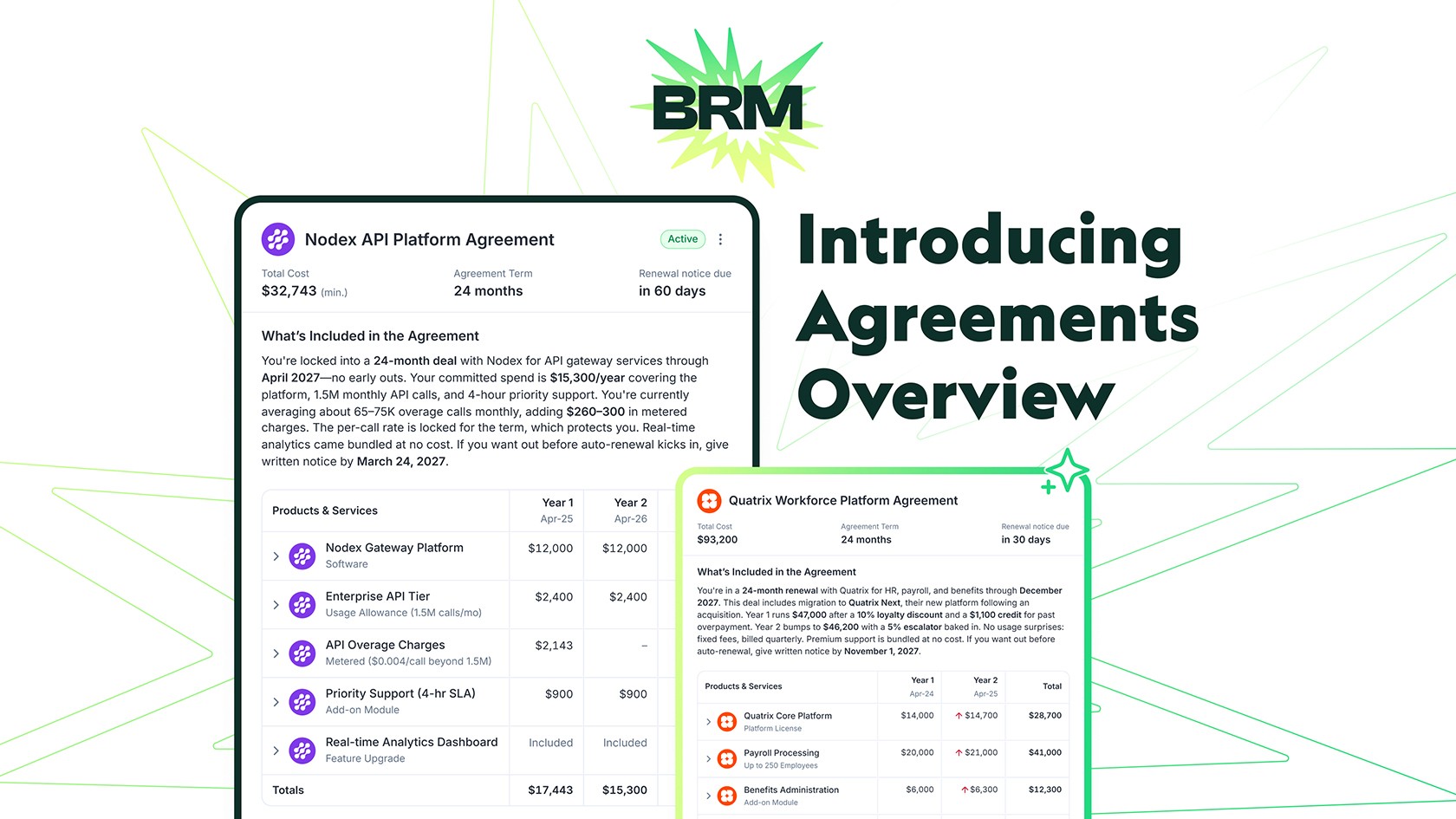
Every contract becomes a live Agreement Intelligence record: what was purchased, what it costs, key obligations, and when action deadlines hit. Renewal tracking, compliance gaps, and notice period alerts are all automatic.
When you have a question — "What's our cancellation clause with Datadog?" or "Which vendors auto-renew in 60 days?" — just ask. BRM's AI assistant gives you cited, accurate answers in seconds.
Sellers have always known your contracts better than you do. BRM fixes that.
Get a demo