
.png)
As companies get serious about their token spend, they need the full picture more than ever.
BRM turns your spend data into a clear view of your AI costs across the whole stack: how much, where it goes, how fast it is growing, and what a usage credit is versus a seat. Connect your card spend, ERP, transactions, and agreements. Setup takes minutes, and the picture builds itself. Live now.
Tokenmaxxing is dead. Long live valuemaxxing.
Token count has been the AI virtue signaling flare for “AI transformation”. More tokens means more progress. More spend means more ambition. The status race is over. We can stop staring at everyone else's usage graph, stop reposting vanity AI token plaques, stop mistaking token count for value creation.
Token usage as a proxy for value was a brilliantly manufactured marketing ploy by the ship builders.
The shift is from tokenmaxxing to valuemaxxing: companies will care less about how many tokens they produce, and more about where each dollar — and each token — takes them. Most know they need to change course; few know how.
We've charted this course before, with the original "intelligence product": people. Headcount used to be the proxy for scale. Now it isn't — companies are doing more with less, and nobody confuses a big org chart with a good business. Token spend is next.
But right now, most companies are sailing straight into the AI iceberg.
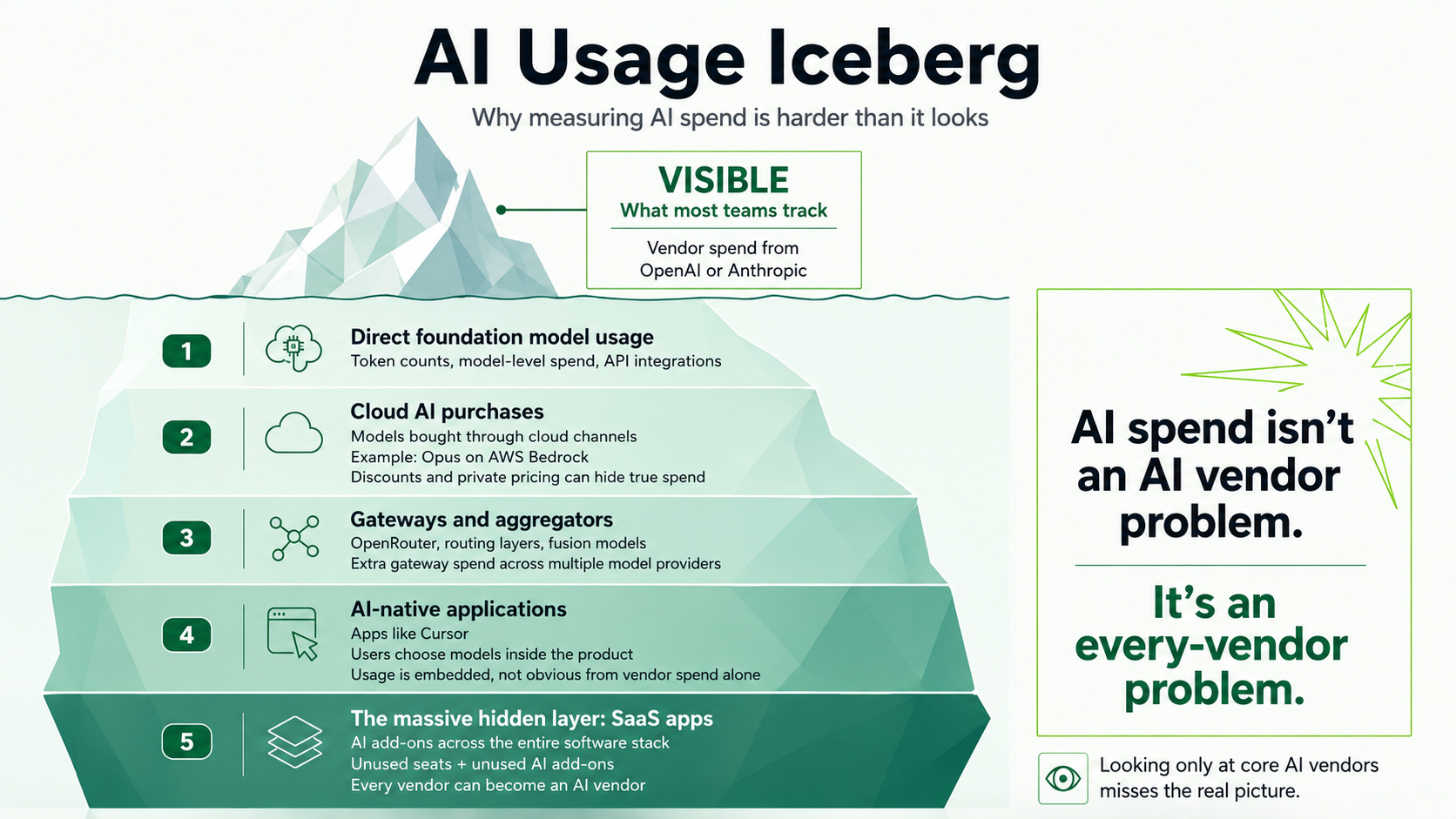
Above the waterline, it looks manageable. You can see the OpenAI bill. The Anthropic contract. Maybe a dashboard with token counts by model. Reassuring. Charted. Under control.
Below the waterline is the mass that tears through the hull.
It's the AI usage being charged dynamically, in places finance doesn’t have visibility. The old Opus still running on Bedrock that engineering didn’t deprecate. Frontier models routed through aggregators like OpenRouter, with gateway fees stacked on top. AI-native apps like Cursor, where your engineers pick the model inside the product and spend attribution is nearly impossible. And the SaaS vendors that were supposed to be dead, fighting back with AI bolt-ons atop unused seats.
This spend creeps up. It is metered by the token, it moves every month, and it hides inside products that don't look like AI at all. Nearly impossible to see, let alone forecast or tie to value. As a result, finance is left staring at two questions from the bridge:
What are we actually spending on AI? And is any of it connected to value?
Most can't answer either one, and no wonder: spending on AI models is on track to more than double this year, scattered across providers, buried in line items, and hidden inside products that don't look like AI at all. This isn't an AI vendor problem; it's an every-vendor problem. Your whole software stack is going AI-enabled at once, and most of it sits below the waterline. For now.
The ships that don't sink aren't the ones with the clearest view of the tip. They're the ones holding a chart of the whole iceberg before they're atop it. Every model, every cloud, every aggregator, every AI-native app, every AI add-on bolted onto a seat nobody uses; scored against the only question that matters now: is this dollar buying value, or just buying tokens?
That chart is what we're building at BRM. We map every vendor relationship in your stack, surface the AI spend that is hiding inside companies that don't look like AI companies, and help tie it back to value creation.
If you can't answer those two questions cleanly today, you're not behind. Almost nobody can. But the companies that map the AI spend iceberg first get to choose their course instead of bracing for impact.
See your own iceberg. We'll map your stack and surface the AI spend under the waterline—what you're paying, and what it's actually buying. It takes a few minutes. The chart is yours; the course is your call.
Tokenmaxxing got you to the iceberg. Valuemaxxing is how you get past it.
The whole-iceberg chart is the mission, and it doesn't arrive all at once. It starts with the layer that's already sitting in your systems, the foundational model providers where AI spend concentrates today.
Chart it.
Now live — a clear view, from the data you already have
Every BRM customer now has a pre-built, always-current view of AI spend.
BRM builds it by connecting to the systems where the spend already lives: card spend, expense management, ERP, email, and your agreements. BRM's Agents read the products off your contracts and receipts, map and normalize them against the global catalog, and assemble the picture. No manual tagging required; it's automagical. You get visibility from day one, not after a long rollout.
It covers AI spend across your entire stack and goes deepest where that spend concentrates today: the foundational model providers, starting with OpenAI and Anthropic. From the start, you have an accurate read on your LLM spend and where it's heading.
Usage credits, separated from seats
BRM's insights, tied to the commercial model, give you the nuanced view you won't otherwise get from card spend and receipts alone. It separates usage-based charges from seat-based plans, by LLM provider and by agreement. An Anthropic relationship splits into API credits, a Team plan, a Max plan, and a Pro plan, each on its own line with spend attribution. An OpenAI relationship splits into the API platform and ChatGPT. You see what is metered, and likely to move next month apart from what is fixed.
Why it matters: you can sometimes infer part of this from a single receipt. Doing it across the entire enterprise, every vendor and every agreement, is the hard part, and tying each charge to how it's actually priced is what turns a stack of vendor totals into spend you can read, attribute, and predict.
What you see
- Run rate and trajectory: total AI spend, last month's spend, a daily run rate, and a projected annual run rate.
- Monthly trend: how spend by vendor has moved over the last twelve months, so acceleration is obvious.
- Month-over-month growth: where spend is speeding up or slowing down, period by period.
- Usage versus subscriptions: API and usage credits split from seat-based plans, the COGS and OPEX of your AI bill.
- Vendor comparison: twelve-month totals, latest month, and month-over-month change for each provider.
- Spend by cardholder: who the AI spend is running through, broken out per person.
All information is classified against a model ontology and taxonomy. Not just a vendor list.
Connect cost to value and revenue
Accurately mapping spend is the first part of the journey. The harder part is proving if spend produces value; most teams remain stuck as usage climbs without a clear link to revenue or results. BRM gives you the foundation to draw that line, because every dollar of AI spend is attributed to the agreement it falls under, the product type, the team or person driving it.
Attributing AI spend to the team and the workflow driving it is the first step toward asking which usage is earning its keep and which is just running. That is how you move from “spend is up” to “spend is up here, driving this,” and decide where it pays and where to pull back.
From visibility to savings
After gaining visibility, you need to take action. BRM will help you determine if committed-use discounts are available, research different providers, compare prices, and suggest alternative approaches to reduce spend, such as prompt caching and batch processing. BRM is arming you with the tools to help make more informed decisions.
Insights on demand
BRM structures and normalizes all AI spend. Powering complex analysis and insights that would normally take an analyst hours. And with reports, the information is not just queryable, but shareable via links, and downloadable for board decks and spend reviews.
BRM’s MCP enables these questions to be answered where you work. And with your own foundational models of choice.
Why BRM, and not a receipt tracker
Pulling your AI receipts into one screen is the easy part. What matters is what BRM does next: it separates spend by its commercial model. A receipt tracker categorizes by vendor and hands you a total. BRM resolves each charge to the agreement behind it and tells you what's a usage credit, what's a seat, and what's something else entirely. That's the line between knowing what you paid and knowing what you're going to pay.
And the picture keeps getting more complicated, because AI is permeating all software, not only the tools with "AI" in the name. The CRM adds an AI tier. The design tool changes its AI policy. The dev tool quietly moves to per-token billing. The same agreement-and-catalog work behind today's view is what will let BRM surface that spend too, including the AI charges hiding inside products you already pay for.
What comes next
Our first report gives finance teams insights immediately off of your current integrations. Flagging the AI spend that concentrates across Anthropic and OpenAI, all built from the transaction and agreement data you already have.
Our second report enables deeper insights. Connect directly with Anthropic, OpenAI OpenRouter, and Cursor to give teams the most granular reporting. Model family, input tokens, output tokens, and spend by model. Claude Opus next to GPT-5 and watch how the model mix moves your bill.
And our third report enables visibility into models hosted by the hyperscalers and neo-clouds (Amazon Bedrock, Google Vertex, Azure OpenAI), more model providers, and a steadily sharper set of recommended actions to bring the bill down.
Valuemaxxing starts with accounting: knowing what you spend, what it buys, and what it will cost next quarter.
Take control of AI spending today.
Want to see how? Book a demo.
More articles
Keep reading on procurement and strategy
%20(1).webp)
Products
Email is now in BRM
Every email with a vendor now sits on their Relationship page, alongside the agreements and the spend. And BRM's Agents draft your next reply knowing the whole relationship, not just the last message.

News
BRM now surfaces the hardest-to-find AI spend.
Your AI bill is only the part you can see. BRM now connects directly to providers, hyperscalers, gateways, and AI-native apps to surface AI spend at the source, resolving every charge to the agreement behind it, so finance can see what invoices never showed.