
.webp)
BRM was founded to help companies manage relationships. Starting with vendors.
What you see today: a fraction of the relationship
Business is powered by relationships. The partnerships you build, the trust you earn, the commitments you fulfill — these determine outcomes. Every deal, every negotiation, every renewal is a chapter in something longer than any single transaction.
Vendor relationships are no different, yet they have been ignored. They've been handed off to tools that think in contracts and invoices, that ask you to manage something living by tracking what you agreed to pay and whether you paid it.
But the contract is not the relationship.
Before every renewal or vendor decision, someone does archaeology: digging through inboxes for the thread that explains the penalty clause, reconstructing the delivery dispute that makes the payment terms make sense, hunting for the promise a sales rep made on a call that never made it into the SOW. The record should be there, but it isn’t.
And every time someone leaves your company, the institutional memory walks out the door with them. Vendors don't have this problem. Their side of the relationship is systematized end-to-end. Yours lives in fragmented systems and people’s heads.
What a vendor relationship actually is
A contract is evidence of a relationship, as is alogin, a payment, an email, a support ticket, a meeting, a renewal negotiation. Relationships are alive; the supposed systems––dead. Until now, systems haven’t been able to assemble, understand, and update relationships at scale; assembling the data was impossible.
Relationships are the atomic unit of B2B commerce.
Each Relationship consists of the living, complete record of the interactions of people, and the systems and companies they work for. of everything that's been agreed to, paid, communicated, and decided between two organizations over time — and that record has always been richer than any contract or invoice ever captured.
Relationships are complex. We believe they consist of four layers
Foundational:
The agreements and the transactional record of the relationship — contracts, amendments, SOWs, order forms, and on one side; invoices paid, deliveries received, and payments made on the other. What was committed to, and the record that it happened. Every other tool in this space has built here and stopped.
Performance:
How the vendor performed against commitments — SLA compliance, responsiveness to support inquiries, delivery of goods. Not just the quantitative data, but also the qualitative data that tells you if they showed up as a partner. Contracts stipulate legal commitments in complex language. The performance layer tells you if they stood by their word. .
Communication:
This is where business lives — emails, messages, meeting notes, call recordings, escalation history, negotiation context. The email chain that explains terms, the Zoom recording of a sales rep's promises, and the internal conversations around expanding with a vendor. This is the layer every other tool has glazed over. It's also the richest one.
Signals:
These capture changes in the Relationship. Contacts moving companies, companies being acquired, l risk criteria changing, online pricing changes, and breaking news — the signals that tell you who's involved, what's shifting, and what deserves your attention before it becomes a problem.
No single layer tells the complete story. Only the complete, assembled Relationship does.
The Relationship View
The Relationship is a dedicated page in BRM for every vendor in your portfolio — a complete, assembled record of all four layers, built automagically from the agreements, payments, communications, and signals that make up the relationship. You connect your finance systems, inboxes, and admin tools once; BRM assembles the rest and backfills the history.
But the assembled record is only half of it. Having every layer in one place is what makes the second half possible: intelligence. AI that reads the complete relationship and tells you what this vendor means to your business, whether they've been a good partner, and what to do next — the data and the judgement, delivered together. That's Relationship Intelligence, and it's only possible when the record is complete.
Navigate to any vendor, and the full picture — and the read on it — is already there, before you ask. That is Vendor Relationship Intelligence.
"Honestly, vendor questions used to mean digging through DocuSign, Slack, and three email threads. Now, it’s one page or one prompt.”"
- Steve Nolan, Director of Financial Operations, Public.com
Here’s what you get
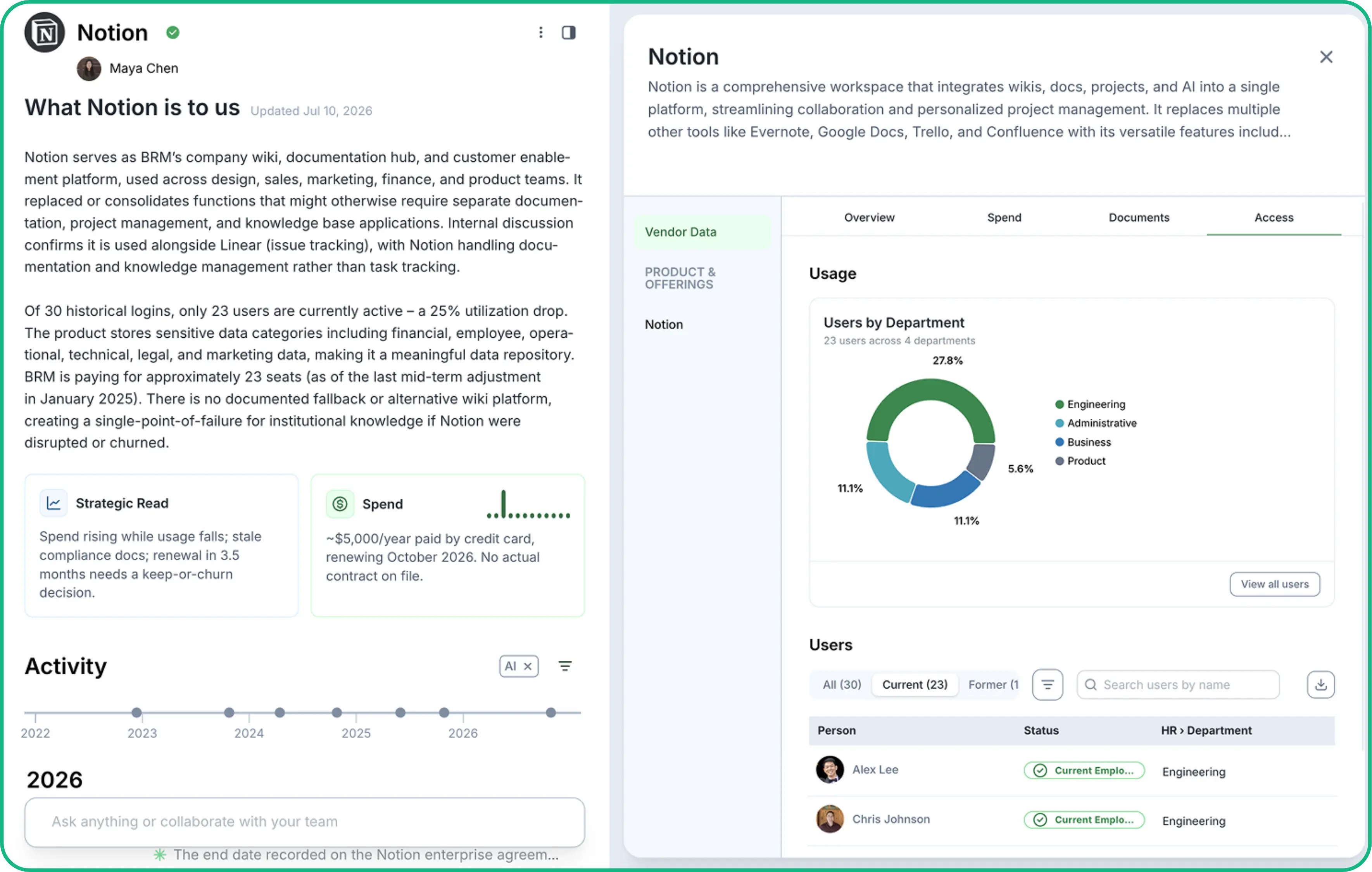
The Relationship overview
An AI-generated briefing of the vendor relationship. What the vendor is to your business, every active agreement and its commercial terms, key contacts on both sides, how the relationship has performed, the strategic read on where things actually stand, and negotiation intelligence for the next renewal conversation. If you have five minutes to make a decision on a vendor, this is where you want to look.
Products & offerings
It brings line items to life by finding and mapping every product and offering from a given vendor. You never have to ask “what does this do?” nor “what’s the status?”. Know exactly what you're paying for, not just the vendor name on a contract.
Spend
Shows the complete financial picture: overall spend, spend trends over time, and spend attribution by product. What you've actually paid, how it's moved, and where the money is spent across the relationship.
The activity timeline
The full arc of the relationship. Every decision and activity catalogued— contracts signed, payments made, decisions taken, emails exchanged, every contact tracked, including who came and went. Intelligence surfaces the moments that actually mattered and why. The timeline isn't just a record; it's also where the work happens. Comment on any event, loop in a teammate, or message the vendor directly. Put BRM’s Agents to work helping you determine what you should do next, grounded in your data in BRM’s intelligence.
Documents, requests, functions, and access
Capture every source agreement and supporting document that makes up the relationship, every purchase request, and all role-based vendor details (Compliance, IT, and Legal) one click away — without leaving the relationship. And for software vendors, access shows you who and what teams are using the product, intelligently driving next steps and actions.
The record persists. The intelligence compounds.
When you can finally see the complete relationship — every layer, stitched together — you know what you're actually paying for and what you've actually gotten. You answer questions before they're asked. Clarity, finally.
And the record isn't a filing cabinet — it's alive. Agents keep it current with every message, every agreement, every token consumed, so the context is always complete and always compounding. No single person ever held the whole relationship in their head. Now the company does, and it gets richer every day, whether or not anyone's watching.
That's what the next era of B2B buying demands. The annual renewal is dying; in its place, consumption that moves daily — token spend, usage-based pricing, commercial terms that drift in real time. There's no once-a-year reckoning coming to bail you out. Relationships have to be managed continuously, with people and agents together. That means agents tracking consumption against commitments, monitoring SLA drift, flagging risk the moment it surfaces in a thread. Your team stops reconstructing the past and starts directing the future. The best relationship managers aren’t replaced. They become superhuman.
Or take a tour
Power to the buyers.
More articles
Keep reading on procurement and strategy
Best Practices
AI Token Spend 101: A Finance Leader's Guide to Usage-Based AI Costs
A finance-first guide to managing AI token spend: what tokens cost, why usage-based pricing is unpredictable, and a 6-step framework to baseline and forecast.
News
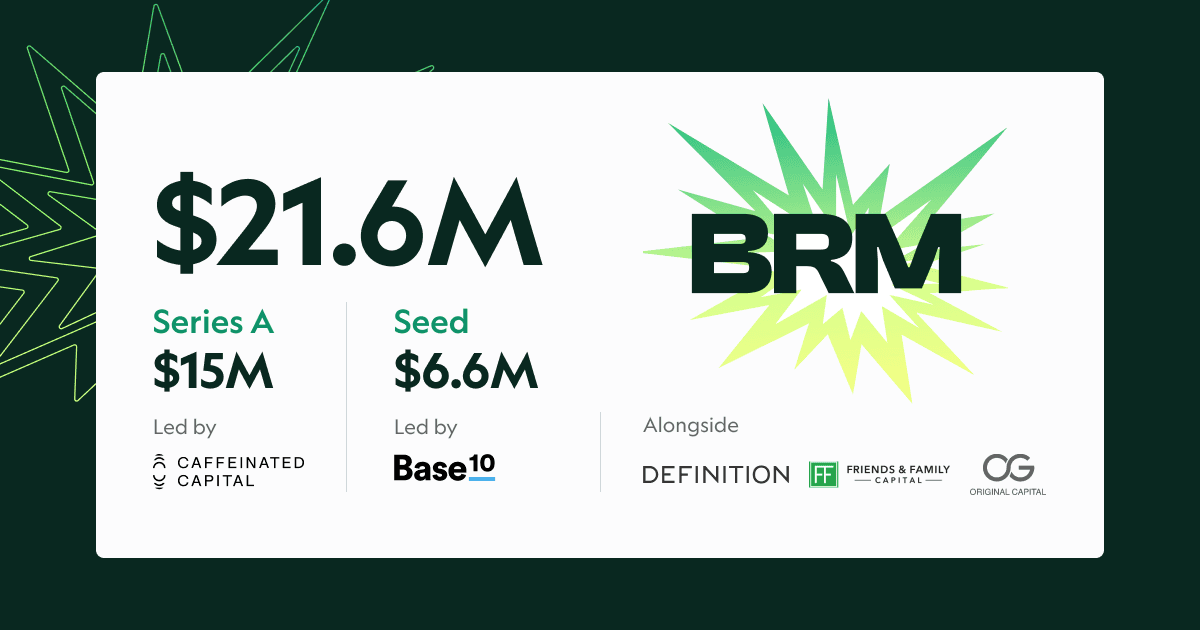
BRM Launches With $21.6M and AI SuperAgents to Help Companies Buy
Buying is broken, but BRM is here to fix it with $21.6M in funding and AI-powered SuperAgents that take on vendors for you, handling everything from contracts to compliance. While everyone else builds AI sales tools, BRM is tackling the painfully ignored buyer's side, already saving thousands of hours for companies like Tegus, Public, and Cadence.